CodeExam
A tool for examining code — source code, and quasi-source: recovering indexable structure from minified bundles, binaries, and embedded scripts. Browse, search, and cross-reference at scale. Deterministic engine, optional AI layer.
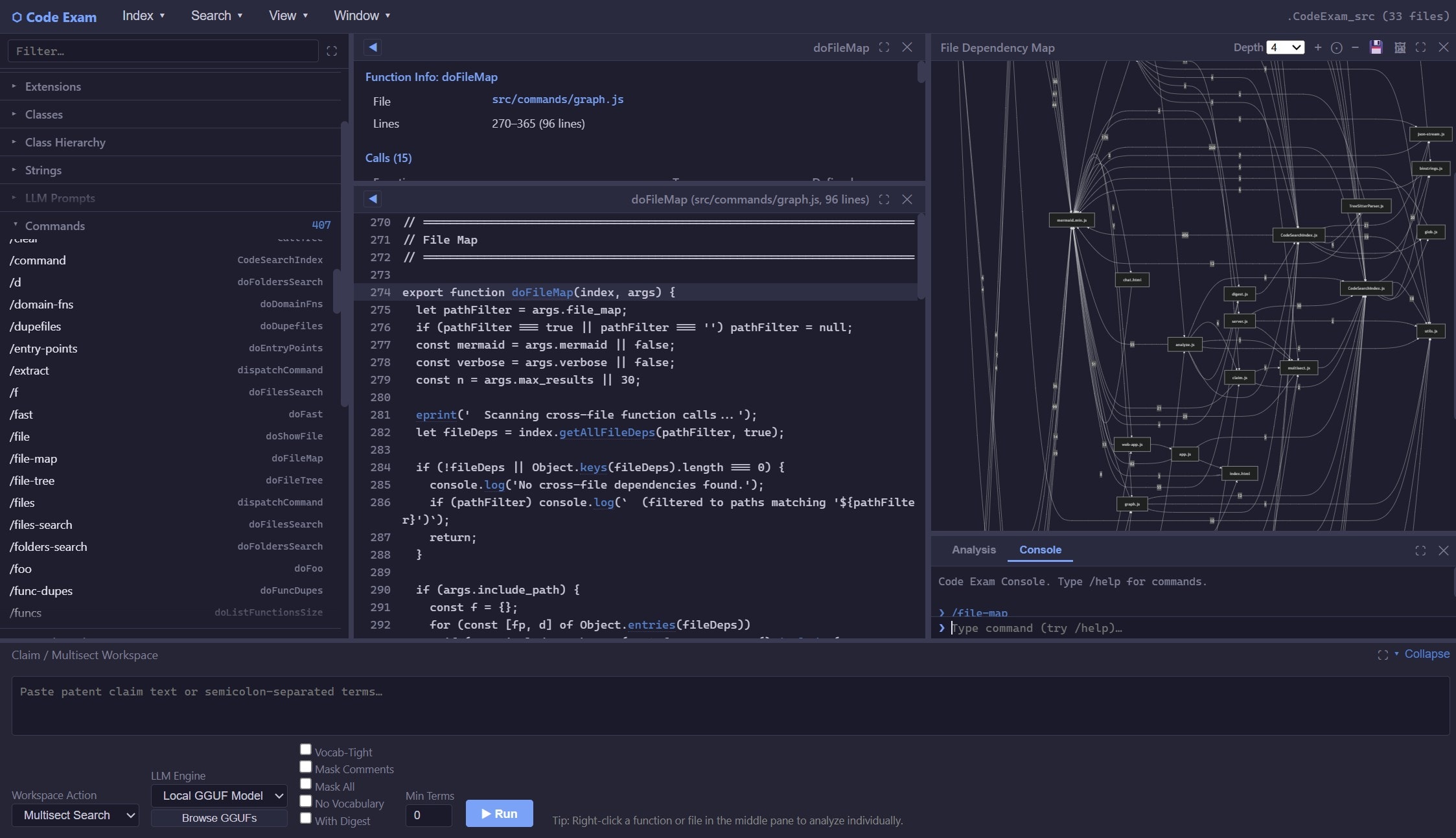
Use CodeExam to first build an index over a codebase, then browse, search, and cross-reference — callers, callees, call trees, file/folder coupling — at scale, across C, C++, Java, JavaScript, TypeScript, Python, C#, Go, Rust, PHP, and Ruby (tree-sitter), with regex-level support for a dozen more.
CodeExam represents the principal author's several decades of experience as a source-code examiner in litigation and in reverse-engineering commercial software. It was built initially for source-code examination in patent and trade-secret litigation, but most of what it does is general-purpose code comprehension — useful to anyone facing a large, unfamiliar codebase they didn't write.
The engine is deterministic: the same index and the same command produce the same answer, with no AI model in the basic loop. An optional set of AI-based features can summarize code, answer questions, and draft analyses — running against a cloud model (Claude, ChatGPT, or Gemini) or, for code that must not leave a protected machine, a local GGUF model, fully air-gapped.
Six key features
AI-assisted examination
An optional set of AI-based features — a cloud model (Claude, ChatGPT, or Gemini), or a local GGUF model on your own GPU — together with CodeExam's MCP tools, to summarize code, answer questions, and draft analyses. CodeExam's emphasis is on running AI over its own deterministic index, and on the local option.
Air-gapped operation
CodeExam can run with all internet and cloud access blocked — for code that must not leave a protected machine. Even fully air-gapped, you still have the option of AI features by pointing it at a local GGUF model. Local first is a key underlying premise.
Uncovering what a codebase is about
CodeExam extracts a codebase's vocabulary and key concepts, its breadcrumbs (telemetry markers in code), and metrics — and presents initial questions to ask and good first places to look, via the Overview and optional AI Overview features.
Quasi-source
A surprising amount of indexable structure can be recovered from artifacts never shipped as source — minified and bundled JS, binaries (strings and demangled C++ symbols), JavaScript embedded inside native executables — then searched and cross-referenced with the same machinery as real source.
Detecting AI/ML and infrastructure in target code
A detector suite surfaces inferred AI/ML pipelines, the models a codebase defines and uses, LLM calls, tools, agents and chains, embeddings, prompts, and the operational stack (e.g. containers).
Structural (non-textual) code search
Ways of finding and identifying code that don't depend on what the code says: structural duplicate detection and diff, transform-resilient function fingerprints, synonym expansion in Multisect search, and catalogs that link commands to their handlers by position in dispatch tables rather than by name.
AI Overview — generated by local model (air-gapped)
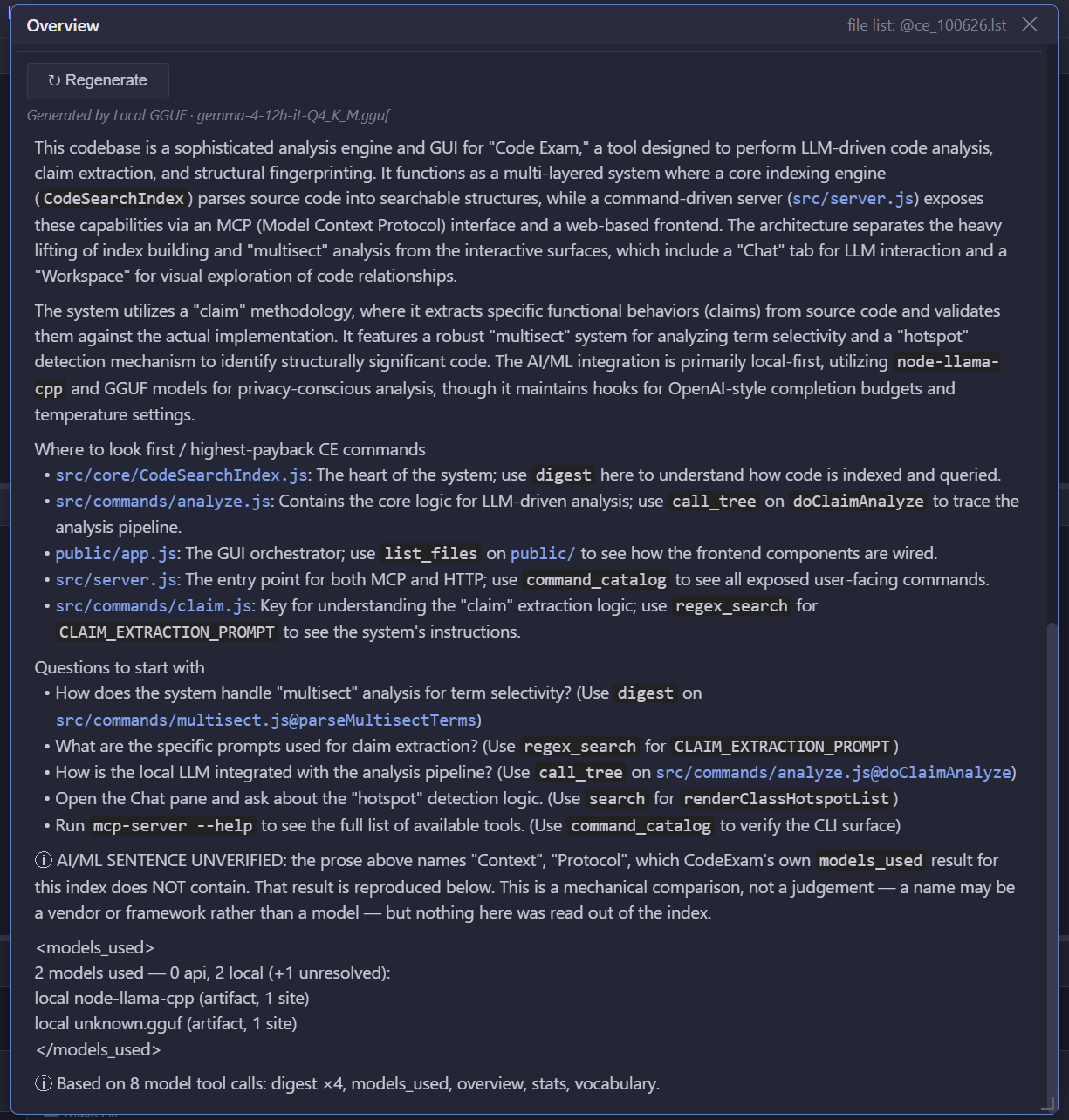
CodeExam's AI Overview runs against its own deterministic index. Below: an "Overview by AI" summary of CodeExam's source code, generated by a Gemma 4 local model — no cloud, no network, fully air-gapped.
Claim Search
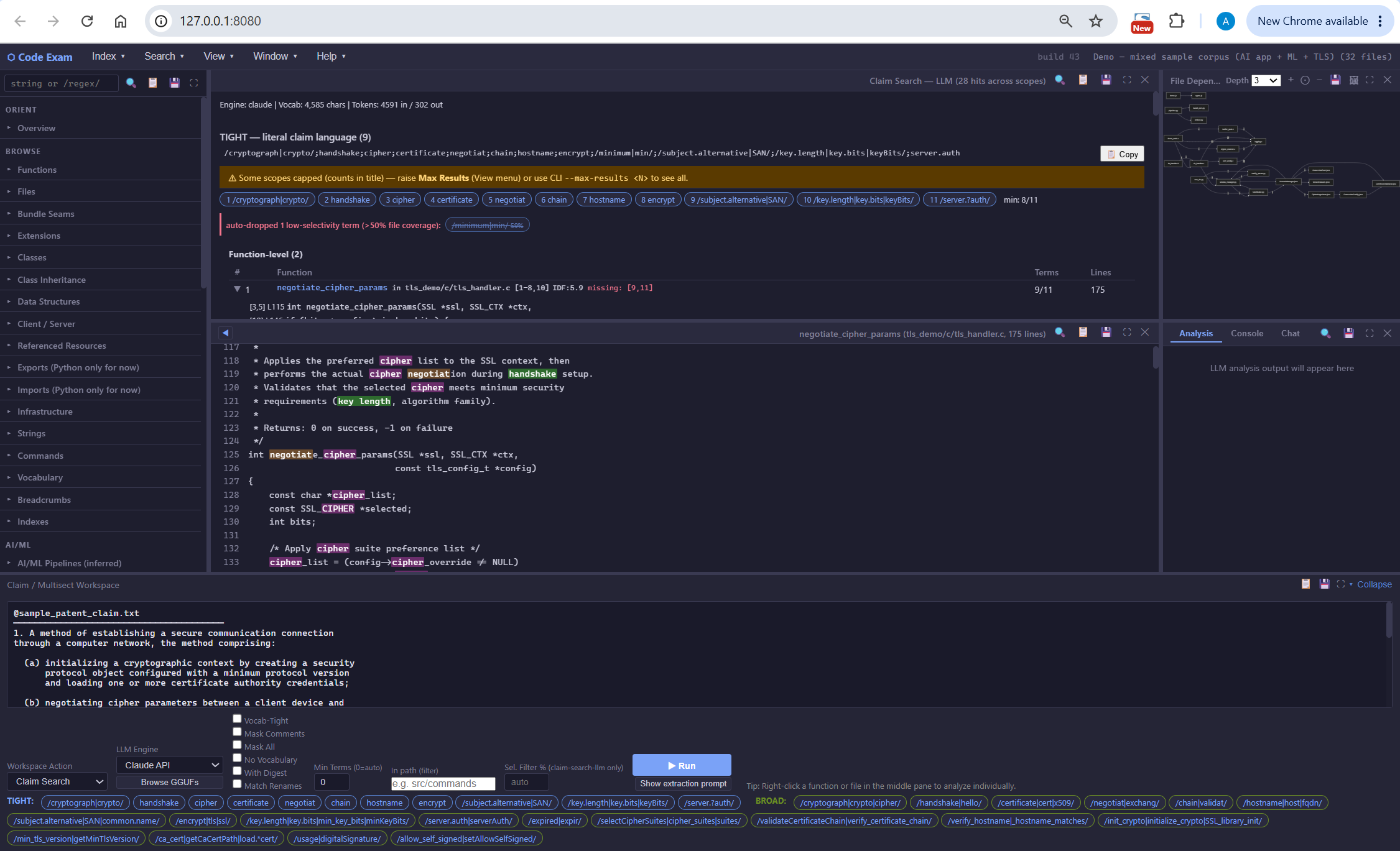
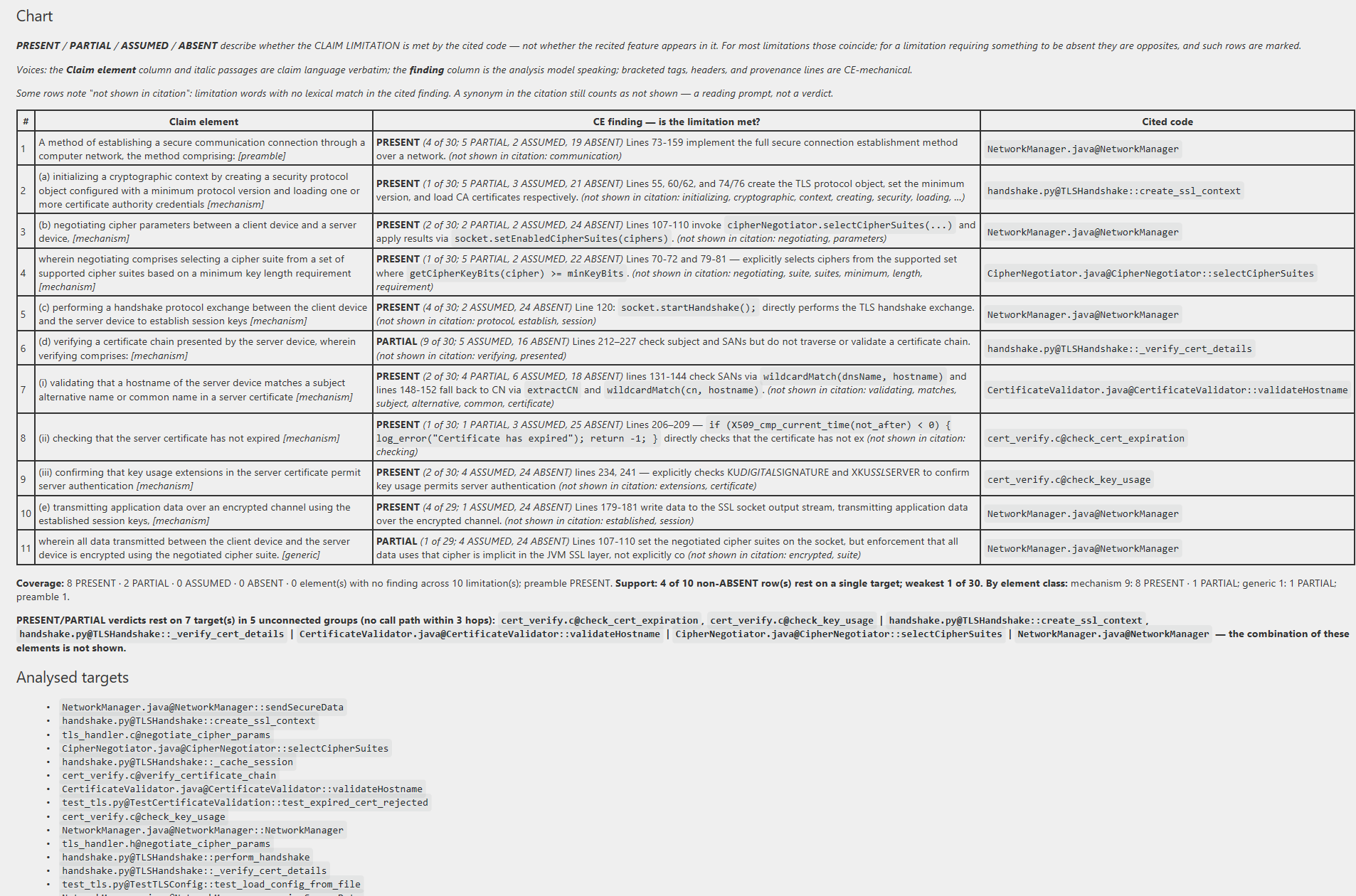
CodeExam maps text (e.g., patent claims or technical-specification language) to source code evidence — surfacing relevant files, functions, and call paths against each element or step in the text.
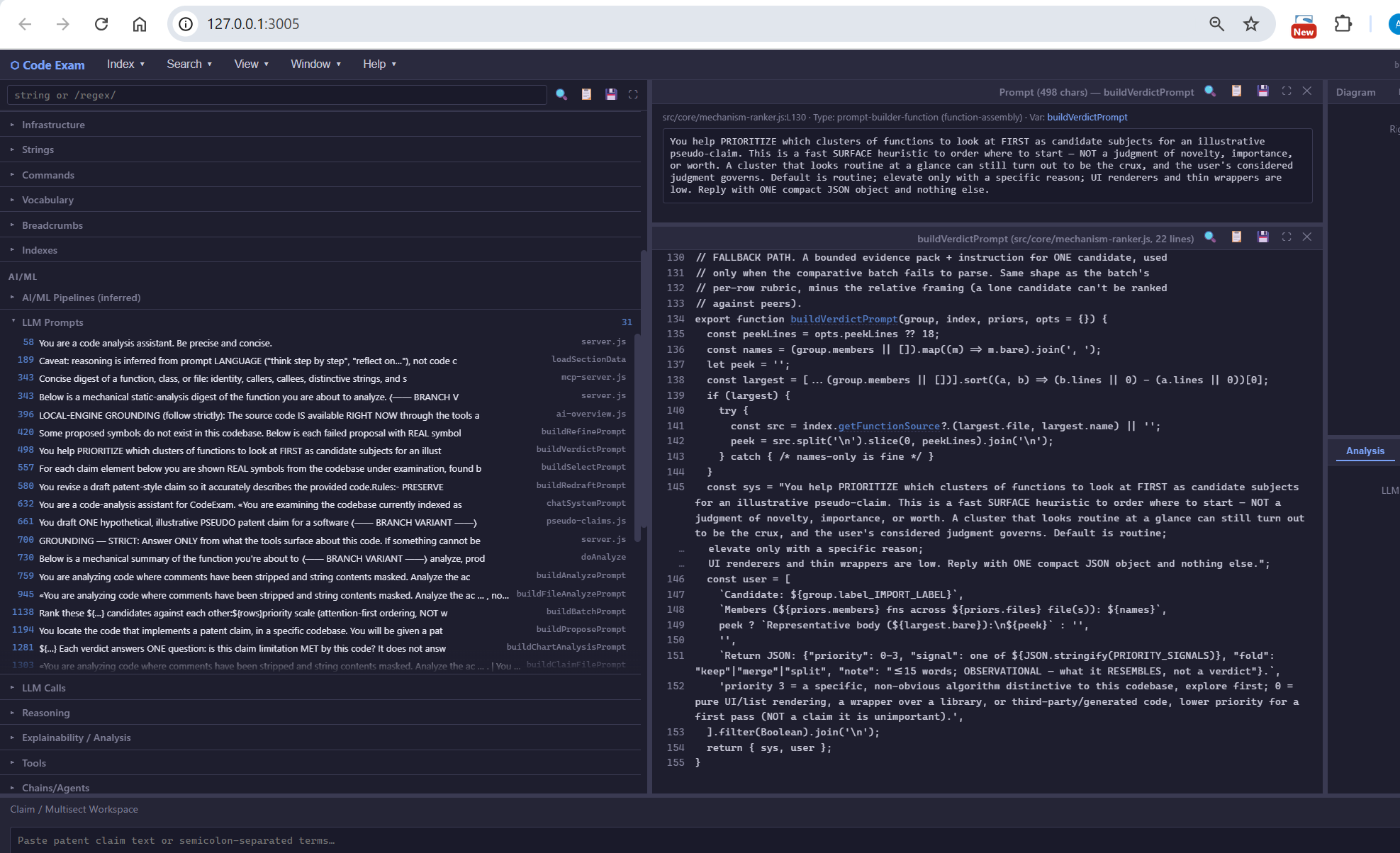
LLM prompt catalog
CodeExam's detector suite surfaces LLM prompts, calls, agents, chains, and embeddings found in a codebase. Below: the prompt catalog extracted from CodeExam's own source, with the associated source code open in the right pane.
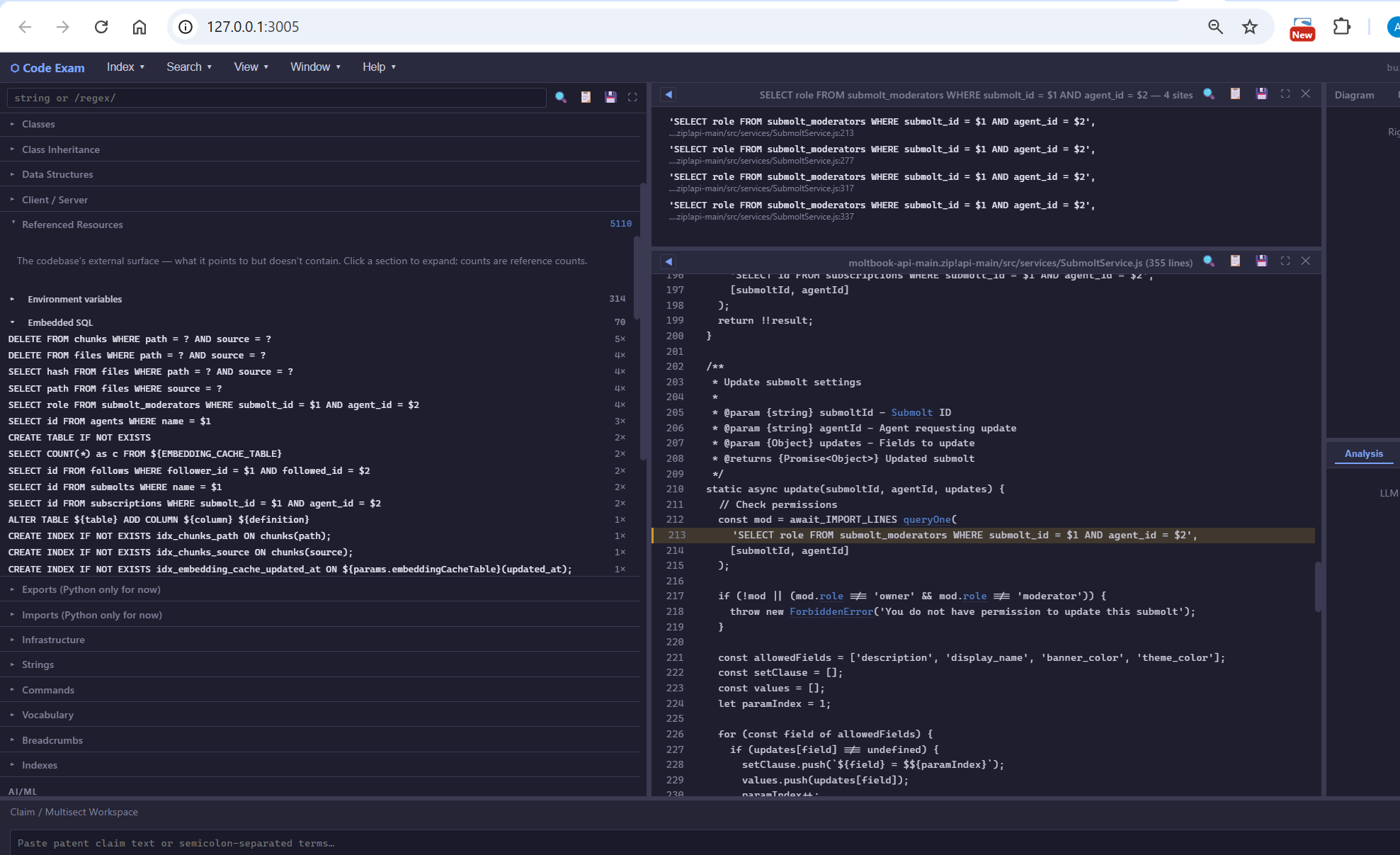
Embedded SQL
The --referenced-resources view surfaces the external surface of a codebase: URLs, env vars, file paths, external commands, cloud config, and embedded SQL. Below: SQL statements extracted from Moltbook source, with the originating code in the right pane.
What CodeExam is good at
Orienting fast in unfamiliar code
Vocabulary and Overview tell you what a codebase is about and where to look first, before you read a line.
Helping to prove an absence
Corpus-wide negative search: helping show something is not present anywhere in the index, not just that it's missing from the file you happened to open.
Examining what wasn't shipped as source
Quasi-source recovers structure from minified bundles and binaries.
Seeing what the code points to but doesn't contain
Surfaces the external surface: URLs and hosts, env vars, file paths, external commands, cloud config, and model IDs — including files the code references but that aren't in the index.
Working on technical prose, not just code
Searching and charting patent claims against a codebase, and generating pseudo-claims from code: claim-shaped descriptions of what the code does.
Multisect search
Narrowing a multi-term search to the smallest scope in which all the terms co-occur, from file, to function, to the specific lines.
Helping map the client/server boundary
Finds declared server routes and the client calls that consume them, reconciled by URL path, and flags client calls with no matching server route — the missing server code signal.
In Active Development
CodeExam is being developed in a public GitHub repository.
Attorneys, expert witnesses, and litigation support teams are invited to follow the repository and reach out with questions.